You’ve probably seen extreme scenarios in films like The Day After Tomorrow, where ocean currents stop and the world plunges into chaos overnight.
Reality won’t look like that.
But the underlying system behind that idea, the Atlantic Meridional Overturning Circulation (AMOC), is real, and it may already be weakening.
For preppers and offshore-minded survivalists, this isn’t a curiosity. It’s a long-term risk multiplier that affects weather, food, water, and migration patterns.
What’s Actually Happening
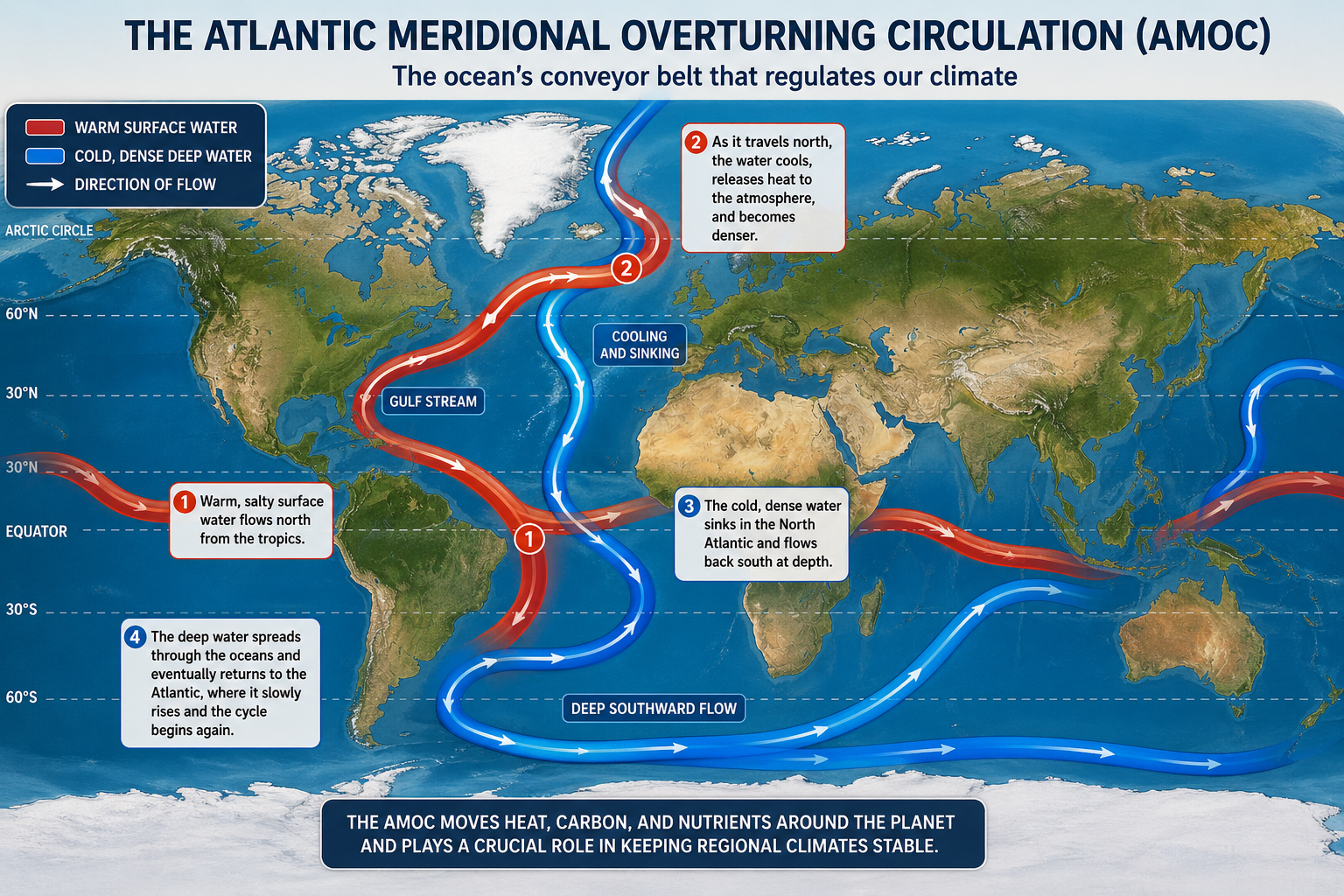 The AMOC is a massive ocean current that regulates climate, especially in the North Atlantic.
- Warm water flows north
- It cools, becomes dense, and sinks
- Cold water flows back south
This cycle helps keep Europe relatively mild and stabilizes weather across the Atlantic basin.
But the system depends on temperature and salinity balance. That balance is now being disrupted by:
- Rising ocean temperatures
- Freshwater dilution from ice melt and rainfall
- Reduced density, slowing the sinking phase
The result is a gradual weakening of the system.
Why This Matters to You
This is not a single disaster you can bug out from.
It’s a system destabilizer, meaning it increases the likelihood and severity of other problems:
- Erratic weather patterns
- Crop failures
- Regional cooling mixed with global warming
- Sea level rise along key coastlines
- Population displacement
In other words, more volatility and less predictability.
Likely Effects You Should Plan For
1. Weather Whiplash
- Warm early spring followed by sudden frost
- Longer droughts interrupted by intense storms
- Stronger storms fueled by warmer oceans
2. Food System Stress
- Lower crop yields
- Failed harvests
- Rising food prices
- Supply chain disruptions
3. Coastal Risk Increases
- Sea level rise
- Increased storm surge impact
- Accelerated erosion
4. Water Instability
- Shifting rainfall patterns
- Drought in some regions, flooding in others
- Unreliable seasonal expectations
5. Human Movement and Pressure
- Climate-driven migration
- Strained infrastructure
- Rising geopolitical tension
Why a Sailboat Becomes More Valuable in a Destabilizing Climate System
Most preparedness strategies are built around fixed locations. That works, until the location itself becomes the problem.
A destabilizing climate changes that equation.
A sailboat is not just transportation. It is a mobile, self-contained survival platform that adapts as conditions change.
1. Mobility Equals Survival Options
When weather patterns shift or regions become unstable, you are not stuck.
- Move away from storm-prone zones
- Relocate based on seasonal changes
- Avoid population pressure and unrest
2. Independence From Fragile Infrastructure
Land-based systems depend on complex supply chains.
- Power grids fail
- Water systems break down
- Supply chains stall
A properly equipped sailboat can operate independently with:
- Solar and wind power
- Watermakers
- Stored and renewable food sources
3. Access to Food Beyond Supply Chains
The ocean is a food source most people ignore.
- Fishing provides protein
- Mobility allows you to follow productive waters
- Reduced dependence on failing agricultural systems
4. Avoiding High-Risk Zones
Coastal cities and low-lying regions are high-risk areas.
With a sailboat, you can:
- Anchor in safer regions
- Avoid flood-prone infrastructure
- Maintain distance from overcrowded urban areas
5. Strategic Flexibility
The biggest advantage is choice.
You are not locked into one failing system. You can adapt in real time as conditions evolve.
That flexibility is something land-based preps cannot easily replicate.
Action Steps: Practical Preparedness
1. Build Food Resilience Now
- Maintain a deep pantry, months not weeks
- Store calorie-dense, long-life foods
- Learn preservation methods like dehydration and canning
2. Water Is Non-Negotiable
- Store significant potable water
- Invest in filtration and purification systems
- Ensure redundancy, especially offshore
3. Reduce Coastal Vulnerability
- Evaluate flood and elevation risks
- Avoid long-term reliance on low-lying areas
- Maintain a relocation plan
4. Design for Instability, Not Comfort
- Build redundancy into critical systems
- Maintain backup power solutions
- Keep manual alternatives available
5. Mobility Is a Force Multiplier
- Keep vehicles maintained and ready
- Plan multiple evacuation routes
- Maintain sailing readiness if offshore
6. Watch the Signals
- Increasingly erratic seasons
- Repeated crop failures
- Rising coastal insurance costs
- Infrastructure strain
The Bottom Line
The AMOC is not collapsing tomorrow.
But it doesn’t need to.
A gradual slowdown is enough to create compounding stress across multiple systems, exactly the kind of scenario that exposes unprepared people.
Preparedness is not about reacting to a single event. It’s about building a life that can absorb ongoing disruption without breaking.
That’s where SailToSafety thinking comes in, adaptability, mobility, and resilience.